

No products in the cart.
The short answer
Yes — but not for the reason most product pages tell you.
Diatomaceous earth mats don’t “wick” water the way a towel does. They pull it into a network of microscopic pores, hold it briefly, and release it into the air as vapour. That last step is the one that matters, and it’s the one nobody explains. It’s also why these mats work brilliantly in some kitchens and disappointingly in others.
If you’ve been staring at one wondering whether it’s a genuine upgrade or a nicely photographed rock, this is the honest version.
What diatomaceous earth actually is
Diatomaceous earth is the fossilised remains of diatoms — single-celled algae with silica shells. Compressed over millions of years into soft sedimentary rock, then milled into powder and formed into slabs.
What makes it useful is the structure. Each fossilised shell is riddled with pores far too small to see, and a single slab contains billions of them. That gives an ordinary-looking piece of stone an enormous internal surface area.
Water hitting that surface doesn’t bead and sit. Capillary action pulls it into the pores almost instantly — which is the effect you see in every demo video where a puddle vanishes in about two seconds.
Why it dries itself
Here’s the part that separates a diatomite mat from a dish towel.
A towel holds water in its fibres and stays wet until you wash it or hang it up. The water has nowhere to go, so bacteria multiply and the towel starts to smell within a day or two.
A diatomite mat holds water in shallow pores with a huge surface area exposed to the air. Evaporation happens continuously across that whole internal structure, so the mat returns to dry on its own — typically within 10 to 30 minutes in a normal kitchen.
Nothing stays wet long enough for bacteria or mould to establish. That’s the actual mechanism behind “odour-free” and “anti-mould” claims. It isn’t a coating or an additive. It’s just physics.
Where they genuinely beat a towel
- Speed. Water disappears on contact rather than being rubbed around.
- Odour. This is the biggest practical win. Damp towels smell because they stay damp. A mat that dries itself never gets to that stage.
- Hygiene. Nothing to launder, nothing accumulating in fibres between washes.
- Appearance. A crumpled towel looks like a crumpled towel. A stone slab reads as part of the counter.
- Longevity. Towels degrade with every wash cycle. Properly maintained diatomite lasts years.
Where they fall short — the honest part
Nobody selling these will tell you this, so here it is.
Humidity changes everything. Evaporation drives the whole system. In a humid kitchen with poor ventilation, the mat takes considerably longer to reset. It still works, just slower.
They saturate. A diatomite mat has finite pore volume. Drain an entire sink of dishes onto it at once and you’ll reach the limit — at which point water pools on the surface and it looks like the mat has failed. It hasn’t; it’s just full. This is the single most common complaint in reviews, and it’s a mismatch of expectations rather than a defect.
They need occasional maintenance. Over months, soap residue, mineral deposits from hard water, and oils gradually block the pores. Absorption drops off. The fix is straightforward — a light sanding with fine-grit paper restores the surface — but it is a real maintenance step people don’t anticipate.
Solid ones are fragile. Diatomite is a soft, brittle stone. A single slab dropped on a tile floor can crack or shatter. This is exactly why foldable and silicone-backed designs exist: the silicone absorbs impact and the hinge lets the mat flex instead of snapping.
They’re not absorbent for grease. Oily residue clogs pores rather than evaporating away. Wipe oil off dishes before setting them down.
How to tell a good one from a bad one
The market is flooded with cheap versions, and the differences are real.
- Density. Higher-density diatomite absorbs faster and lasts longer. Cheap mats use more filler and less diatomaceous earth — they feel lighter and stop absorbing within months.
- Backing. A bare slab slides on the counter and cracks when dropped. A silicone base solves both.
- Food-grade certification. This sits directly beneath things you eat off. Confirm the materials are food-grade rather than assuming.
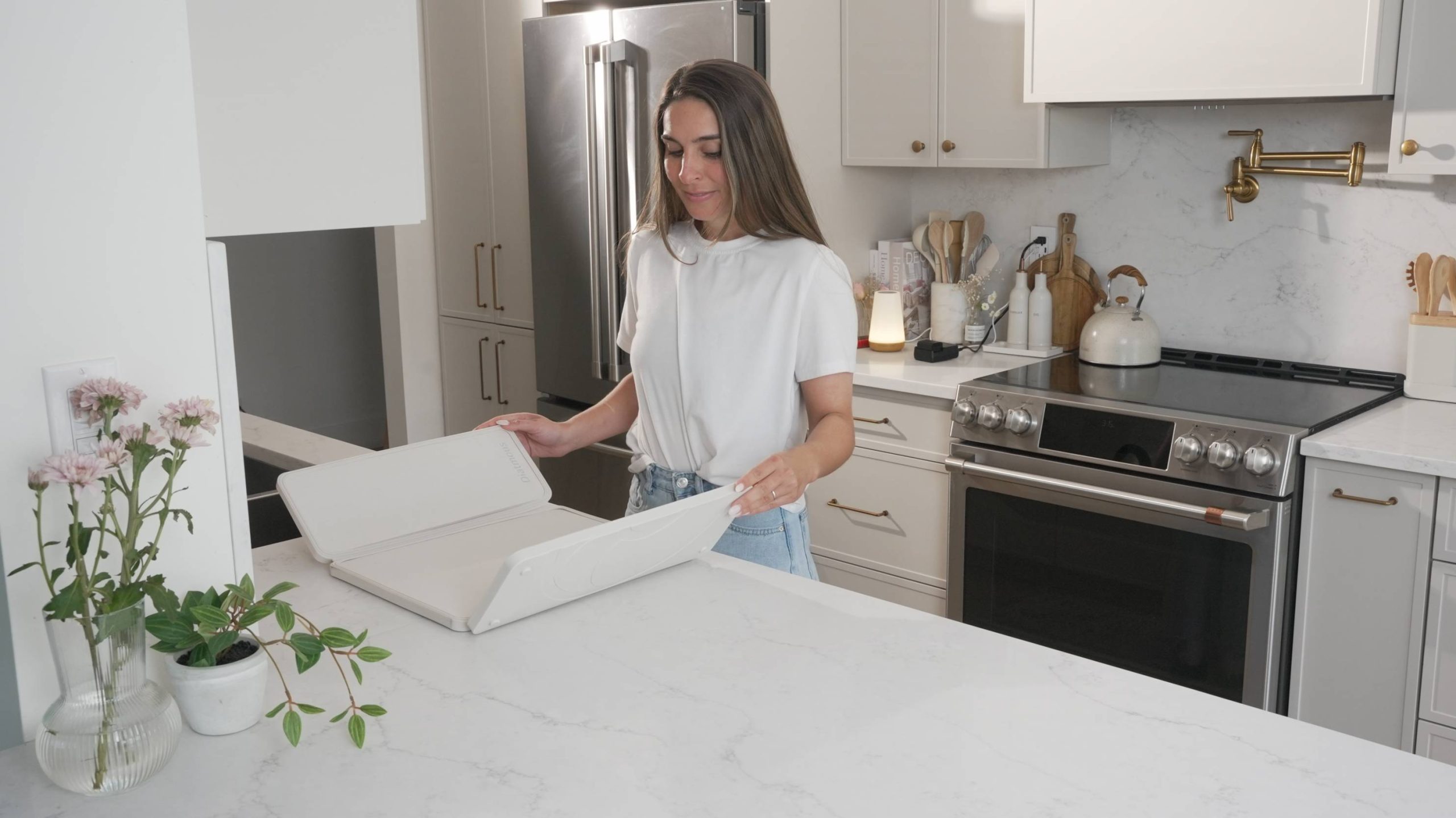
- Construction. Solid slabs are rigid and awkward to store. Foldable designs store flat in a drawer, which for most kitchens is the difference between using it daily and leaving it in a cupboard.
Getting the most out of one
- Shake excess water off dishes before setting them down
- Give it air — a mat pressed against a backsplash dries far slower
- Wipe oil and grease off dishes first
- Sand lightly with fine-grit paper when absorption slows, every few months
- Don’t put it in the dishwasher or soak it in soapy water
- Stand it upright occasionally to let both faces breathe
So — worth it?
If your dish towel smells by Wednesday, yes. If you want your counter to look intentional, yes. If you’re replacing towels every few months, the maths works out quickly.
If you routinely flood the counter with an entire sink’s worth of dishes and expect zero maintenance forever, you’ll be disappointed — as you would be with any material.
The technology is genuinely sound. It’s ancient geology doing something modern textiles can’t. Just buy a dense, food-grade, silicone-backed one and treat it as a surface that needs occasional care rather than a miracle.
The Diatmous™ Stone Dish Drying Mat is built around exactly these constraints — high-density diatomite for fast absorption, a food-grade silicone base for grip and impact protection, and a fold-flat design so it stores in a drawer instead of taking up permanent counter space. Every order plants one tree.
Frequently asked questions
Do diatomaceous earth mats grow mould?
Not under normal use. Mould needs sustained moisture, and a diatomite mat dries within roughly half an hour. Mould only becomes possible if the mat sits permanently wet in an unventilated space.
How long does a diatomaceous earth drying mat last?
Several years with basic care. Absorption slows over time as pores clog, but light sanding restores it.
Is diatomaceous earth safe to use around food?
Food-grade diatomaceous earth is widely used in food processing and filtration. Confirm the mat is made from food-grade material rather than industrial-grade.
Why has my mat stopped absorbing water?
The pores are blocked, usually by soap film, hard-water minerals or oil. Sand the surface lightly with fine-grit paper and absorption returns.
Can I put it in the dishwasher?
No. Prolonged soaking and detergent drive residue deep into the pores. Wipe with a damp cloth and let it air dry.
Diatomite mat or microfibre towel — which is better?
Diatomite for odour control, appearance and low maintenance. Microfibre for handling very large volumes of water at once and for portability.
